
Multi-year Desktop and Onsite IT Outsourcing Architecture
Multi-year Desktop and Onsite IT Outsourcing Architecture
Multi-year desktop and onsite IT outsourcing: ticket channels, spare parts strategy, resident vs per-visit support, bilingual reporting.
Project context
- Setting: HK / Macao / GBA / mainland multi-office
- Scale: International company APAC offices needing bilingual support
Challenge
International companies operating in China often need ongoing desktop and onsite IT support that HQ can understand in English while local staff work in Chinese. Challenges include unclear ticket ownership, missing spare parts, and oscillate between “full-time resident” and “on-call visit” without a written model. This case documents a multi-year outsourcing architecture: channels, spare strategy, resident vs per-visit labour, bilingual reporting.
Environment
- One or more offices across HK / GBA / mainland hubs
- Mix of corporate laptops, local printers, network closets
- HQ IT retains architecture authority; local partner executes
- Business hours primarily; critical events handled per signed agreement
Solution architecture
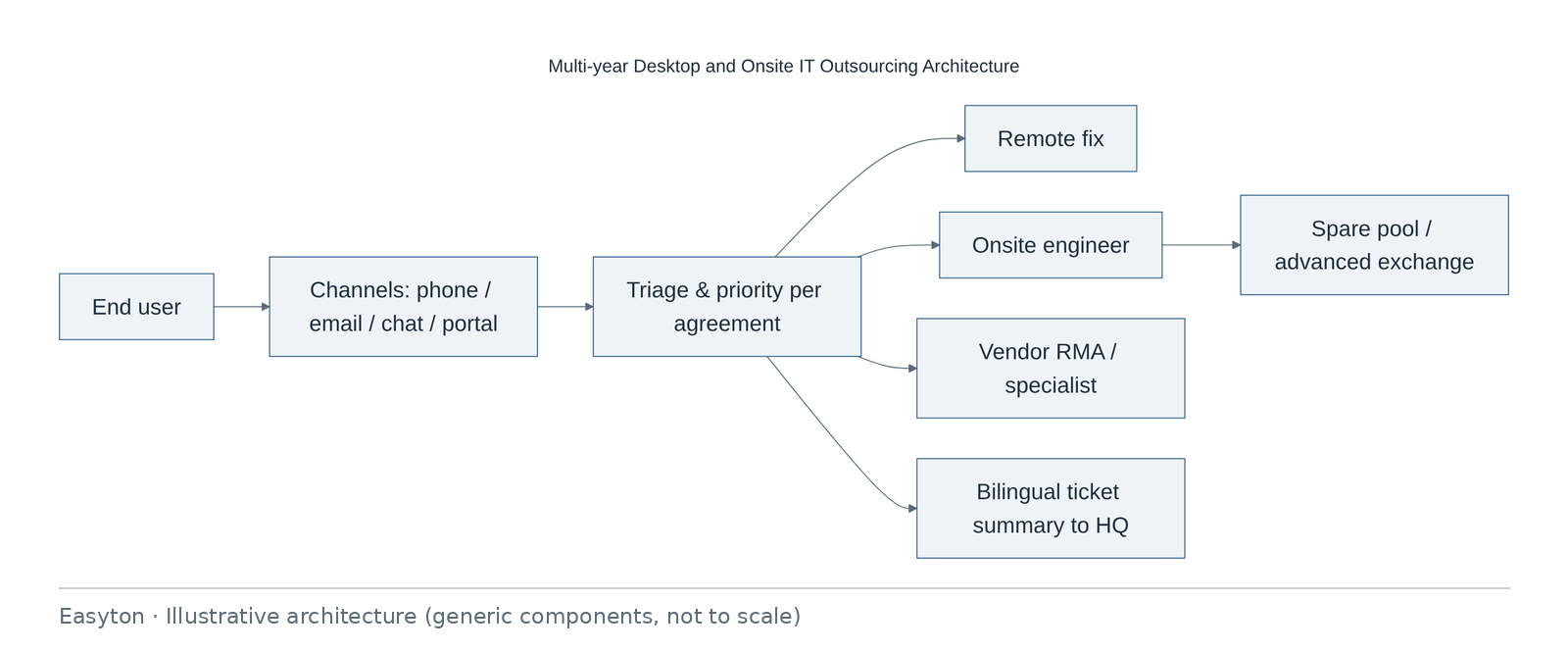
Text view of the architecture (each line: component → what it connects to):
End user → Channels: phone / email / chat / portal
Channels: phone / email / chat / portal → Triage & priority per agreement
Triage & priority per agreement → Remote fix, Onsite engineer, Vendor RMA / specialist, Bilingual ticket summary to HQ
Onsite engineer → Spare pool / advanced exchange
Labour models (choose per site):
- resident part-time
- resident full-time
- scheduled visits
- on-demand visits
- hybrid
Technical highlights
Service catalog characteristics
- In-scope examples: OS incidents, account unlock coordination, printer, Wi‑Fi client, cable patch MAC, break/fix staging.
- Out-of-scope examples unless added: ERP functional consulting, software product development, unsupervised production OT.
- A clear catalog sets expectations more reliably than a generic SLA number.
Ticketing and priority
- Priorities defined in agreement language (e.g. service-affecting vs single-user).
- Response targets follow the signed agreement rather than generic marketing figures.
Spares and logistics
- Spare laptop/PSU/AP pool sizing is site-specific; the agreement defines a spare strategy for each site.
- RMA custody chain documented.
Security & access
- Engineers use named accounts; privileged access logged where tooling allows.
- No shared “company password” spreadsheets in handover—recommend password manager enterprise patterns.
Reporting
- Regular bilingual digest: ticket themes, open risks, change calendar.
Multi-year rhythm
- Annual service review; refresh of the asset list; optional project SOWs peel out large changes (cabling, CCTV) so outsourcing stays steady-state.

Implementation steps
- Discovery workshops (sites, tools, ownership matrix).
- Draft service catalog + labour model options.
- Agreement & onboarding (accounts, VPN, spares location).
- Run tickets; tune categories.
- Regular reporting cadence.
- Periodic spare/audit check.
- Annual review → renew/adjust.
Acceptance (onboarding)
| ID | Criterion |
|---|---|
| O1 | Service catalog signed |
| O2 | Ticket channel live with test ticket |
| O3 | Spare location & custody documented |
| O4 | HQ reporting recipients confirmed |
| O5 | Escalation contacts listed |
Deliverables
- Service catalog
- Labour model sheet
- Onboarding checklist
- Ticket taxonomy
- Monthly report template
- Spare custody SOP
Outcome
A durable bilingual outsourcing architecture connecting end users, local engineers, and HQ reporting.
Related
Easyton has delivered IT infrastructure and support projects since 2009. Planning something similar? Contact Easyton to discuss your requirements.